Everybody Loves Hypnotoad

The Marathon Man
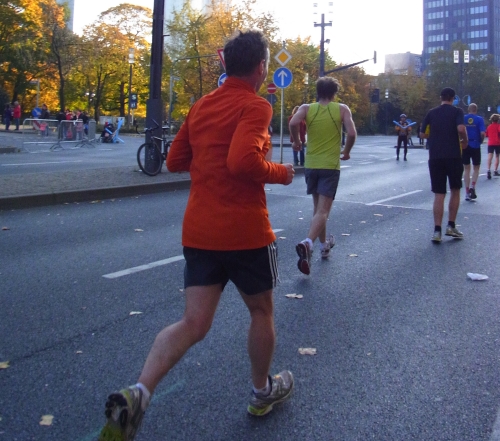
The man in the orange jersey is my dad. He’s awesome and that is not just because he ran a full marathon today. That’s all that needs saying for now.
Lift Up Thy Head
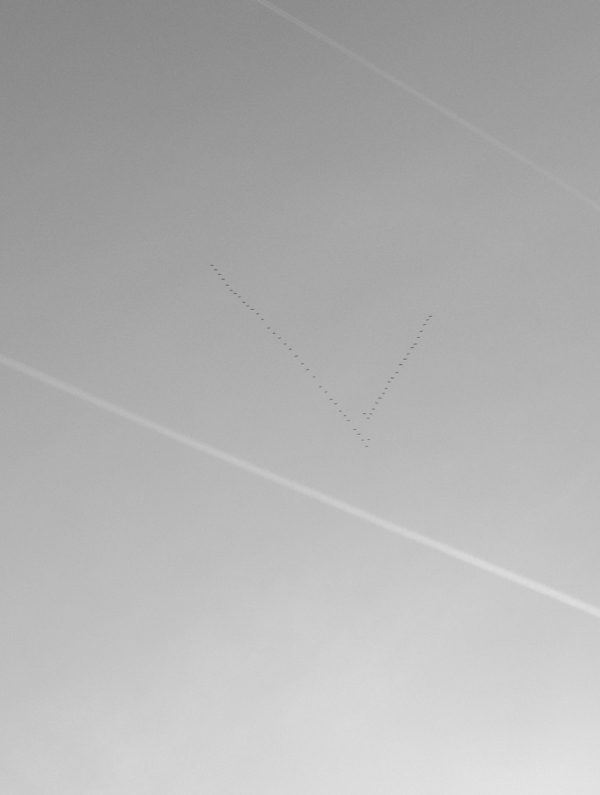
Walking home after shopping today we hear the most peculiar sound: something resembling a mixture of the war cry of invading space monkeys and the forelorn cooing of a giant pigeon. At first we are at a loss as to where it is coming from – there’s nothing visible at street level, no car, no other people, nothing – and then we look up. Above us, so small that they are only black dots against the blue-grey sky, are literally hundreds of geese. At least I think they are geese, they look rather big, too big to be ducks or terns, and there are too many of them to be any kind of bird of prey.
We can still hear their cries long after they are gone. And then, suddenly, the sound swells again and the next group comes flying over the rooftops. They are heading west… I wonder where they’re going.
Baby tiger! Seal! and other photos
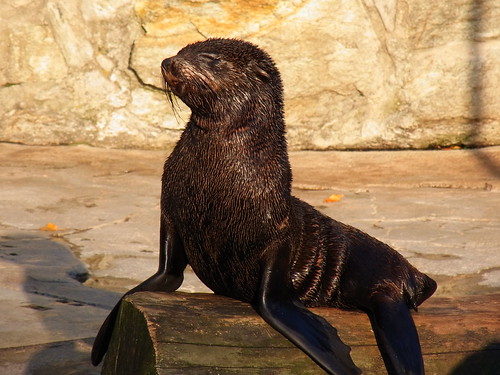
No new blog posts, but I have new photos up on Flickr!
My Name Is Bob, Sire.
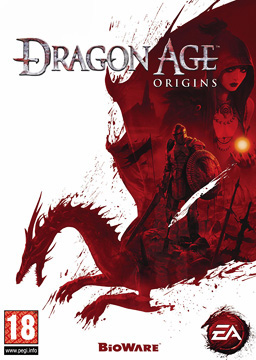 I haven’t written about a computer game in a while… mostly because I haven’t played any in a while (unless you count Spider Solitaire and First Person Tetris). That will change soon as the next month is packed full with releases that I’m really looking forward to. Gothic 4, Two Worlds 2 (the release has been pushed back) and Fallout: New Vegas. The scent of add-ons and sequels lies heavily in the air this fall. (And then there’s also the Borderlands Game of the Year Edition, which I suspect to be the cheaper way to get all those juicy DLCs.)
But for now let’s talk about a game that’s not a sequel or a prequel or any other kind of let’s-wring-more-money-out-of-this-dried-out-lifeless-franchise-quel: Dragon Age: Origins. Not that there isn’t a lot of greed involved in this one. The game has been out for less than a year and already there’s an add-on, a whole slew of DLC’s, two novels and a board game. Soon there will be a trilogy of flash games, an anime movie and for all I know a squeaky chew toy for all your geek-dog needs. I find this a little disconcerting, but on the other hand both the publishing industry and Hollywood have stepped up the pace a little when it comes to release dates and sequels and such and it is really too much to expect the games industry to miss out on all that fun (and money).
Yes. Dragon Age… First a little something to keep the confusion at bay: for all of you who wonder about the fequent use of “we” in a single player RPG: I played the game together with Jonas, which means that he did most of the clicking and I did a lot of “go over there… no over there… there!… stop turning, will you?… you missed a bit of loot… oh, it’s just a dagger.” It’s fun, trust me.
We played a Dalish Elf named (slightly embarrassed pause) Bob. Which isn’t really anyone’s fault, at first we just wanted to try out the game and then we kind of got sucked in… with the wrong name. There is an argument to be made, however, for either not dealing with the name issue at all (like in Gothic) or having a preset name. I’m not going to make that argument, at least not at length, because I don’t write articles about game design theory. In brief, that other approach has two main advantages: a) you can record dialogue for the player-character, which will do wonders for the immersion and b) you don’t end up with names like Gandalf the Awesome or, well, Bob, which really doesn’t do much for the suspension of disbelief. Dragon Age went the other way there. It’s not the end of the world, but I thought I’d mention it.
Dragon Age: Origins puts you in a quasi-medieval fantasy world called Ferelden. Depending on your choice of character and class you will play through one of nine individual intro-adventures that will take you at least ten minutes to play through. Okay, I’m being sarcastic again. The Dalish Elf intro isn’t that bad. Predictable, but not a total loss. And you meet some of the characters from your intro again later in the game, at least with most scenarios, which is a nice touch. But even at the very beginning of Dragon Age I couldn’t help but notice how incredibly linear the game is. I hadn’t played a BioWare game before and I have to admit that I had trouble believing Jonas when he told me just how bad it would be. Sure, in the first dungeon you can choose between going right or left at one point, but both options will end you up at the same cut scene, so where’s the difference? If you’ve played BioWare games before I trust you’ll know what I mean when I say that every area might just as well be a single straight path. If you didn’t… just imagine visiting a very strange nature reserve with a nervous guide who keeps reminding you to never go off the path since otherwise the invisible walls will come and get you.
Once you’re done with the intro you’ll inevitably find yourself in the camp of the Grey Wardens. They’re nice chaps, actually, who enjoy drinking the blood of super-evil demon-spawn and long, romantic evenings by the campfire. And soon you’ll be one of them, rejoice! Dark and gritty games being what they are, things don’t quite go according to plan. You manage to join the Grey Wardens, but unfortunately not much later your king as well as the majority or your new brothers-in-arms get slaughtered by the darkspawn and you kind of get blamed for the whole mess. Treason is involved, naturally, but try telling that to the soldiers that are coming to kill you.
The rest of the plot is essentially all about stopping the Blight, an invasion of darkspawn led by the Arch-Demon, by bringing the different races and factions of Ferelden out of their respective holes and onto the field of battle, and about getting a new king onto the throne. Not necessarily in that order.
Dragon Age has good and bad in it. The good is very good and the bad is… a lot.
What is good is mostly the voice acting and writing on the various NPCs that you can pick up as companions during the course of the game. Dragon Age has a list of characters (and actors) that would put many a Hollywood movie to shame. The cast list on the IMDb has well over a hundred actors, amongst them such august names as Tim Curry, Kate Mulgrew, Dwight Schulz, Tim Russ, Dominic Keating (did they get their hands on an old Star Trek contact sheet?), Claudia Black and Robin Sachs. And while I’m here to praise the voice acting and not fault it, I must say that unfortunately most of the actors named above are wasted on tiny bit-parts. Way to go, BioWare.
Where was I? Voice acting… good. There are a few characters in the game that are just brilliant. Morrigan, for one, although the writers seem to be oddly unsure if she’s really one of the good guys or not. Claudia Black voices her with such a wealth of sarcasm and irony that one cannot fail but love that character (we did, she’s one of the available love interests). Kate Mulgrew lends her scratchy voice to Flemeth, a minor character, but a memorable one. Tim Curry, the biggest name in the cast, is sadly a little colourless as Arl Eamon; I for one wouldn’t have suspected him behind that character. The real gem of the game, however, is the to me totally unknown Steve Valentine as Alistair. There were times in the game, when the combat system was being particularly obnoxious and the plot more transparent than usual, when all that kept us playing was innocent, cute, funny Alastair. The writing on the character, who also happens to be the by far most important NPC, is superb, and you really learn to adore him. By the end of the game we were making a lot of our plot decisions on the basis of the will-Alistair-approve principle (okay, also on the we-don’t-really-care-because-this-is-too-obvious principle, so what?). BioWare games often have, or so I hear, great voice acting and decent writing, but when it came to Alistair and a handful of other characters it really impressed us… and we played Gothic, so we’ve got high standards. (Oh, and then there’s the Leliana issue… the half-Russian, half-French, half-British character that is 150% badly voice acted. Yeah, she wasn’t very good.)
Unfortunately there is a lot of bad to balance out poor little Alistair. I’ve already mentioned the linearity of the game in terms of the terrain. The plot itself is not dissimilar in that respect, just like on the maps you can sometimes choose if you would like to go left or right first, but you always end up with the boss-level enemy at the end of the dungeon.
And the game is small. Again, both in terms of plot and terrain. Sure, there are fourteen or fifteen main locations, each with half a dozen maps attached, but since all you can take is the scenic route along the carefully designed walkway of inevitability, most of these are quickly explored. Denerim, the capital of Ferelden, is particularly disappointing, since it basically only has the marketplace and a few other, tiny locations that don’t give you very much to do.
Speaking of markets: the game has a big problem there. The merchants restock for the last time about halfway through the game. After that there nothing more to look forward too, a severe problem for me (seeing that I am a girl it is only right and proper that I prefer the shopping to the chopping). The unique items are few and far between and often neither really cool nor fairly priced. They did some good with the runes, but then again you can only find a handful of the good ones in the entire game.
Another big problem is the entire messy mess that calls itself a combat system. Okay, so we’ve seen worse, but the developers of Gothic 3 should be hung, shot, quartered and poisoned, preferably at the same time, so that does hardly count. (On second thought… Risen was good, so why don’t we hang, shoot, quarter and poison the bloody release-date-rushing publisher JoWood instead?)
You will play most combat situations with a group of four characters at your disposal. Four characters who can be set either to “be big boys” or “won’t be able to tie their own shoelaces”. In one setting they will merrily run after anything that wags its tail at them, regardless of their own mortality, in the other setting they will stand still, idly picking their noses, while an ogre is biting chunks out of their thighs. Neither are ideal, as you can surely see. The maps are all basically two-dimensional and (again) linear, which pretty much takes the fun out of strategy, and even if that weren’t the case, strategy is only possible at the no-shoelaces setting, which complicates things a little. Oh… and then there’s the camera, which hasn’t been told that we are playing a real-time RPG (as oposed to a turn-based strategy-game) and thus is determined to be stuck on top of your characters at all times. No, I didn’t want to see that dragon halfway down the corridor, why do you ask?
Yes, of course, there’s good too, like the wide range of attack spells that are available to the magic users, but in the end that always led to the fighters picking their noses while the Two Mage-ettes, Morrigan and Wynne, picked off the enemies at their leisure. Not ideal, dear BioWare, not ideal at all.
In the end, after all the fighting and selling and questing and what little exploration there is, the most disappointing thing of all was the plot. The game has a built-in progress indicator somewhere on the character screen and don’t let that sneaky little bastard fool you. Dragon Age: Origins stops at the 50% mark, for whatever damn reason. This was, needless to say, a little bit of a disappointment to us, because… how to put it… WHICH OF YOU CLOWNS CAME UP WITH THAT F***ING IDEA?
That’s not the only problem though. Somewhere around the halfway point (25% in Dragon-Age-speak), the game managed to make us really care about Alistair and the future of Ferelden. Alistair, as I should maybe mention at this point, is one of the possible options for replacing the recently-deceased monarch. And at some point you get to make that decision. Who shall rule Ferelden? We, naturally, decided on Alistair and after that the character kind of vanishes from the game. Oh, sure, he’s still there and you still get to talk to him, he even fights with you provided that you made certain choices earlier on, but somehow the spark is lost. And the same goes for the rest of the characters, really. Writing-wise the air goes out of the game like out of the balloon that snogged a hedgehog. They tried to do all these epic, giant speeches and battles and all that it amounts to is a long succession of cut scenes with battles inbetween that don’t allow you to save for hours on end and that you’re too afraid to skip because there might be a good bit hidden somewhere in all that muddle. (There isn’t… go ahead and skip like your life depended on it.)
It’s a shame really, because without the disappointing ending Dragon Age might have been a good game. Not great, but decent. As it is it barely beats Divinity 2, which isn’t saying much since I’m less and less impressed with that one the more I think about it. I don’t think we will be buying the add-on (Dragon Age: Origins – Awakening), not after that ending. The sequel maybe, but only because it looks like they’re trying to fix a few of the problems that the first one had. Not sure Hawke beats Bob as a name though.
The Twilight Experiment: Day 7
 Rejoice! I’ve decided to do three reviews about the last book of the Twilight series, not just two as with the others. It’s longer, it’s much worse than the other three, and it’s split into three parts anyway. All wonderful reasons for my decision.
This also gives me the chance to say something about the second book, New Moon, that had escaped my attention so far. I was sitting at my computer late one night, thinking about how Stephenie is really sort of (ret)conning the reader when it comes to her werewolves. I think I need to go into the plot a little. At some point in Eclipse, or it might be the end of New Moon, I’m really too lazy to look it up right now, Edward tells Bella that it’s her fault that all those strapping Quileute boys started turning into big cuddle-wolfsies. She replies that he is an idiot (which would be the first true observation that Bella has made or will make in the books) and tells him that Jacob thinks that the werewolves started to change because the vampires came back to Forks. Somewhen after the events in Twilight, I assume, since Jacob shows up at the end of that one and everything is still right as rain, no torn shorts in sight yet. That puts us somewhen in the beginning of New Moon, yes? Mhm… so the werewolves started to change back when Edward and his family had skipped town to get rid of Bells? Yes, you heard right. Jacob thinks that the presence of the Cullens caused him and his biceps-studded friends to change, but if I am not very much mistaken Edward had already left town for quite a while when Sam Uley turned, not to speak of all the others. Mhm… is that scuttling sound I hear faintly in the distance maybe Stephenie slinking off to hide under a rock somewhere? I think it might just be.
Where was I? Yes… Breaking Dawn. 699 pages, 700 if you count the words The End (atom paperback edition). A nice number and one that continues the trend of making the books a little longer with each instalment. It unfortunately also continues the trend of making the plot a little thinner each time we return to Forks, but that only makes my job easier, so why am I complaining?
Breaking Dawn starts off just a few weeks after the events in Eclipse. Bella is, sadly, still alive and set to marry the vampire of her heart in just a few days. She’s also driving a Mercedes Guardian (a semi-fictional car, for those of you who are wondering about that as well; apparently Stephenie is referring to the S600 Guard model). Now, I have a big problem with that first chapter. The reason? It’s a bit embarrassing, but here we go: I once tried to write a novel about a clumsy girl. It was about much more than that, of course, but I will still one day write that novel so I won’t tell about what exactly. The thing is that I tried real hard to make the physical aspects of being clumsy funny and it just didn’t work. This first chapter of Breaking Dawn, with all the wheel-screeching and brake-slamming and whimpering, reads a lot like that ill-fated novel of mine, only much worse. It takes a lot of work to make something be funny on paper that should by rights be in a Buster Keaton movie.
Mhm… yes. After the car scene we move on briskly to the telling-Charlie-scene, which is a flashback and one of the few funny things in the book. Funniness aside, I still have to marvel at all the lovingly hand-crafted inconsistencies that go into every Charlie Swan scene in this book. If the man keeps to one mood for more than half a paragraph it’s a miracle, really. Maybe he’s got bipolar disorder, I hear that’ll do that to you. Or maybe Stephenie just thinks that angry parents are funny and doesn’t want to let the plot get in the way of a “good” joke. You pick.
Soon after, Bella is striding down the altar in a spectacularly ugly wedding dress. Yes, I know, it’s a taste thing. She hasn’t any – that’s the problem, I think. The wedding is done not much later, a surprisingly anti-climactic scene really, given that we’ve been… eh… waiting for this for three entire novels, but then Stephenie has soooooo much more in store for us. Before the post-nuptial fun can begin, however, Jacob shows up and almost kills Bella. What’s a wedding without a bit of good-natured bride-slaughter, eh?
Then the honeymoon, the bit that I’d been looking forward to. Not because I can’t wait for Bella and Edward to finally enter their very own happily-ever-after (frankly all I’m waiting for is for Bella for fall off a cliff), but because of the sex. Yep, you heard me right. Twilight has finally grown up and is now going down the well-trodden softcore-porn path to hell. Sex has been an issue, but never a feature of the novels before that fate-full honeymoon chapter. Edward is afraid that when it comes to eating someone he might have gotten the definition a little wrong. Bella is just horny and doesn’t care about anything except when she’s finally getting laid. Foolish human hormones, as Edward is so fond of saying. Now here’s a little problem: the Twilight vampires are, essentially, frozen in time. Nothing ever changes. Their hair doesn’t grow, their nails don’t lengthen, blood doesn’t run in their veins (instead of blood they have sparkly fairy-dust, I assume). Which raises some interesting questions when it comes to sex, especially if you’re a he-vampire, don’t you think? And don’t get me started about all those foolish human hormones that Edward is so fond of.
So, are we to assume that Edward has had a hard-on for the last hundred odd years or so? Just thinking out loud. What I was really getting at, though, the center-piece of the first part of Breaking Dawn, so to speak, is the morning after.
Bella wakes up after a night filled with hot vampire sex and is happy. Edward is not quite so happy, and soon we find out why. While he hasn’t eaten Bella (in the blood-sucking sense), he’s at least come close to doing so. A sort of post-coital snack, perhaps? He’s also gotten a little carried away (excitable boy, doesn’t know his own strength) and now Bella looks like a smurf only with more hurt and less smurfberries. I’ve just had a very long discussion with Jonas on why this honeymoon-domestic-violence scene makes me react this strongly. There are several reasons, not all of them rational. For one, Twilight is just so incredibly tame, at least so far. Bella and Edward never do more than kiss, and it is a noteworthy event when the fanged-one takes off his shirt in Bella’s presence the night before they get hitched. So this sudden transition from tame to date-rape seems slightly off. Then there’s the fact that afterwards Bella basically lights a metaphorical cigarette and whispers through the equally metaphorical smoke I like it rough honey, let’s do it again.
Now, I know that some people are into that kind of thing, just like some people are into feet or latex or penguins, and there really is nothing wrong with it provided that all participants are okay with it, but in this case it seems… strange. And wrong. It also seems to suggest that anything more than kissing before you get married is a sin paramount even to premeditated murder, whereas a little post-nuptial wife-beating is totally cool. A (male) friend of ours once told me that this scene makes him angry because it seems to say that sexual violence is okay as long as you’re married and that it also seems to be saying some rather nasty things about males in general. So at least I’m not alone there. All in all, the whole vampire-human sex thing seems wrong. Wrong in how it clashes with the fuzzy safe-not-sexy logic of the rest of the series. Wrong in how Bella reacts to it. Maybe I’m being hypocritical.
The rest of the first part is relatively brief. Edward tries not to have sex with Bella and ultimately fails. Bella tries to have sex with Edward and… well, you guessed it. A mysterious old Native South American lady enters the scene and casually gives us the solution to all the problems that lie ahead, but no one listens to her because they are too busy (not) having sex. It’s interesting to see that Mysterious Natives are everywhere, though. I mean, it’s a good thing that they’re all so mysterious, otherwise Bella and Eddie would be in a right fix at the end of the book, but still…
In the end Bella discovers that she is pregnant and that opens up a whole new barrel of laughs. But that’s a story for the next part of the Twilight Experiment, in which we will deal not only with the question of whether or not it is a good idea for Bella to spread her genetic heritage, but also with the sheer agony of 200 pages being narrated by the only character that manages to be more obnoxious than Bella Swan: Jacob Black (cue dramatic music).
Hibernation
It’s been quiet around here lately. Jonas is working like a madman on his new game project and I… I seem to have gone into artistic hibernation. Germany is doing its best to be as grey and cold as it can be and I’ve let it drag me right down with it for the last week or so. Okay… I did some graphics tests for the troll game and they looked stunning. That’s something. Right?
Anyway. I shall better myself. Expect a new instalment of the Twilight Experiment tomorrow and for today just admire the pretty new blog-header.
Chili Con Carne
 So… post about cooking, attempt the second. I’ll try to make this a regular feature on this blog now. Keep your fingers crossed.
Today: Chili Con Carne. I got this thing about making stuff entirely myself, no spice mixtures, no supermarket bread… I do allow soup cubes and canned broth, though. You can buy some rather decent spice mixtures for chili here in Germany, but I feel bad about using those, even though they don’t contain anything chemically offensive, like artificial colouring or flavour enhancers. It’s a Verena thing. So I’ve been on the hunt for an edible chili recipe for ages. And there’s a lot of them out there, let me tell you. Chili with beef or lamb or pork. Chili with cumin or thyme or basil. With beer or broth or red wine. With cayenne pepper or tabasco or fresh chilies. With vinegar or Worcestershire sauce. I could continue for quite a while, but I trust you get my drift.
In general I find that recipes that use wine as a base tend to taste too much like Bolognese sauce and those that use a lot of exotic spices such as cumin, coriander and curcuma tend to taste too much like curry. So, after searching for more than a year and trying a good dozen recipes in the process, I settled for using a mixture of all the recipes that worked best so far, and the result was surprisingly pleasant. (I also used way too much cayenne pepper the first time around and almost killed all our guests… trial and error, my dears, trial and error.) I serve my chili with sour cream to take off some of the hotness, so give that a try too, if you like.
Shopping List for 4:
2 small onions, chopped
3-4 cloves of garlic, finely chopped
2 tbsp olive oil
500 g/17 oz of ground meat (pork/beef mix is best, but feel free to go wherever your dietary restrictions take you)
2 cans kidney beans, drained
1 can skinned tomatoes in juice
1/2 leek, chopped
300 ml chicken broth
1 tsp ground thyme
1 tsp ground oregano
1/2 tsp ground rosemary
1/2 tsp sage
1 laurel leaf
as much cayenne pepper as you dare (I use 2-3 tbsp and it’s plenty hot)
salt & pepper
(optional: freshly chopped coriander leaves)
For the sour cream:
1 carton/200 ml sour cream
juice of 1/2 lime
3-4 spring onions, chopped
salt & pepper
Heat the oil in a saucepan and add the onion. Fry for maybe three minutes until the onion is very slightly browned, then add the garlic. Fry for another minute. Add the meat and fry until well-browned and crumbly.
Add the kidney beans and the tomatoes with the juice and bring to a boil, then add the leek.
Add the broth and bring to a boil again, then add all the spices except the coriander. Cover the pot and let it simmer for at least forty minutes, stirring occasionally.
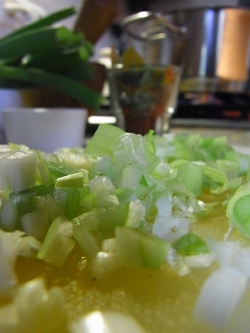
Now is a good time to prepare the sour cream. Stir the sour cream until it is smooth and season with salt and pepper, then add the juice of half a lime and three or four finely chopped spring onions. Cool until serving.
Once the chili has reached a nice, thick consistency, add the freshly chopped coriander (if using) and pepper and salt to taste. You can also add more cayenne pepper now if it isn’t hot enough.
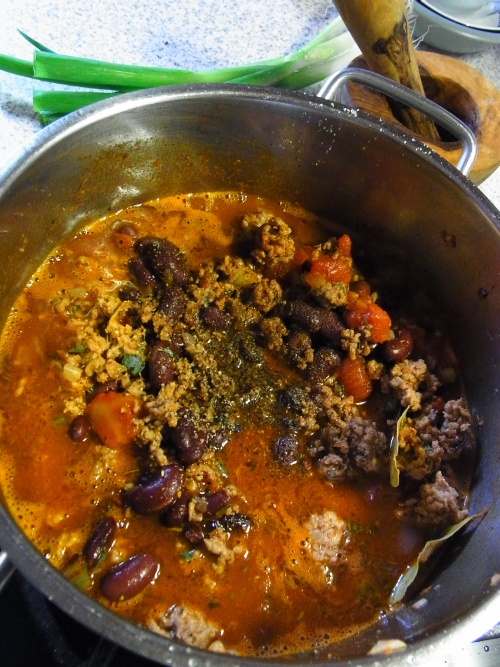
Serve with the sour cream mixture and bread. And beer. And tortilla chips. And… ah, never mind.
Brightly Woven

I am once again left awed and humbled by Guy Gavriel Kay. The Lions of Al-Rassan, which I read last year, left me very impressed, maybe to the point where I was a little afraid to read more of his work, afraid that Al-Rassan was the exception rather than the rule. I finished reading The Fionavar Tapestry last night and it really wasn’t as good… it was better.
The story seems unpromising at first, more the stuff of fan fiction and of fourth-grade essay-writing than of a fantasy epic: five university students from Toronto get transported to Fionavar, the first of the Weaver’s worlds. Loren Silvercloak, a mage, is the one who brings them from one world to the other. He says he has been tasked to bring these strangers to celebrate his King’s fiftieth year of rulership – and although that is not untrue, there is so much more for which Kimberley, Kevin, Jennifer, Dave and Paul are needed in Fionavar.
And that is as far as I want to go in terms of describing the plot. While I don’t have any qualms about spoiling the plot of a bad novel, I don’t want to say too much about something this excellent. Read it yourselves, I say.
A few things can be said, though, without delving too deeply into the plot. Kay is a master storyteller. Back when I wrote my review of The Lions of Al-Rassan I mostly emphasized how lovable the characters are, and the same goes for Fionavar. The only difference is that where Al-Rassan is very detailed and takes it slow, The Fionavar Tapestry soon plunges headlong into the story, a mad rush of settings and events and characters. The three books of the trilogy have, if you add everything up, just barely over a thousand pages. That doesn’t sound short, true, but the trilogy is in every sense a fantasy epic. I’m not saying that the books are too short, not at all, but the writing is incredibly compressed… and still very brilliant, page after page. While the first book, The Summer Tree, seems more like an introduction to Fionavar and its rich history and wealth of characters, the second and third books, The Wandering Fire and The Darkest Road respectively, deal more intimately with the five protagonists and their motivations. And Kay pulls off an amazing feat in that respect. The characters never fall back into cliché; even (or maybe especially) when you think that you got one of them figured out, he or she will usually do something that goes against all those worn-out storytelling conventions that make most other fantasy “epics” so unreadable.
There is one other thing that makes these books so special, though. Pessimism has become very hip today. Just look at Patrick Rothfuss or Joe Abercrombie or any other of the new fantasy superstars. Not so with Kay and The Fionavar Tapestry. If there is one thing that permeates the entire series it is how good its characters are. Not just well-written, but good to the core of their beings. They love the Light, as Kimberly would say. And she’s right. Just like in Sunshine or Battle for Terra, you just feel for the characters, love them and hope that nothing bad will befall them, because they believe in the good in everyone, and so by extension do you while reading about them.
These are three very special books. I don’t know if I will ever re-read them, because the first time around was a very intense experience and I often find it hard to submit myself to such experiences a second time. But I really, really advise you to give these books a chance. They are well worth it.
 Verena Kyratzes