The Green Grasshopper

g

This was lying in front of our hotel room the other week. I shudder to think of what they look like when they are jumping towards your face on the beach. Yes, you guessed right, it is the Bright Green Grasshoper From Hell. And yes, it is as big as it looks, ten centimeters I’d say. That’s about three inches for all our friends out there who have not yet embraced the comforts of the metric system.

For me, metric system or not, that is about four magnitudes of yucky too much.

Later we also saw a live one. I even gathered enough guts to take a picture (holding the camera very far away from me, resisting the temptation of tying it to a long stick).

Sometimes I am happy to be living in a country that has no specimens of insectoid megafauna on special offer. But only sometimes. Like when the Bright Green Grasshoper From Hell is on a collision course with my nose.

My Yellow Slave Markings

My yellow AI wristband chilling on the beach

My yellow AI wristband chilling on the beach

Here they are. They look almost pretty on the picture, don’t they? Innocent. Alluring. Put me on, they whisper. Very quietly, soothingly, waves sing in the background. We are harmless. Just a yellow wristband. Pretty yellow. Nice yellow. We will provide food and shelter.

The truth is that more than my green hat they proclaim me to be a tourist. One of the worst kind, I suspect. An AI-tourist. Just one step above a colonial overlord returned to the island to once again subjugate the peaceful natives.
As a punishement I have to wear these yellow markings. They mark me as a victim for all to see, a victim with a fat purse ripe for the money harvest. The bracelet says: Offer her cigarettes, day trips, your granny in a wheelchair, her granny in a wheelchair, it doesn’t matter, she will buy.

There is a secret language to these markings. Yellow means German. Red means French. White and green American, I think. Green? Spanish? It has gotten to the point were we try to speak to shopkeepers in English and they answer back in German. Jonas has no discernible accent. How do they know? The yellow whispers to them, that is how they know.

The overall effect is that the two of us dive for cover whenever we see a native come towards us with that friendly talking-to-the-tourist-grin. Surely that is not the intended effect.

Signs

y

I am fascinated by the profusion of “caution: wet floor” signs that litter the grounds of the hotel. One can hardly take two steps without falling over one of them. Now that’s what I call a safety hazard.

One of my law teachers at university once patiently explained to the class that supermarkets, hotels and the like often put these signs up just in case. If anything happens, anything at all, banana peel, bird shit, alien invasion, the institution in question can always blame the customer.

“What? You saw a Martian war cruiser and slipped? Didn’t you see the sign? It’s really not our fault if your continent has been incinerated, you didn’t pay attention to the sign.”

Charming. But I can’t help but think that it is a bit silly to keep them in the hotel hallways at any time of day. They can only pretend to clean the floors so often, after all. I’m still waiting for the night when I leave our room to go to the imaginary ice dispenser at the end of the hall at three in the morning and see an underpaid maid scrubbing away at an already immaculate tile off in the far hazy distance…

The Dominican Republic Experience

Although there are still quite a few posts from our time in the Dominican Republic in the pipeline, mostly because our USB stick took a swim in the sea ten days in, the time has come to say some general words about our trip.

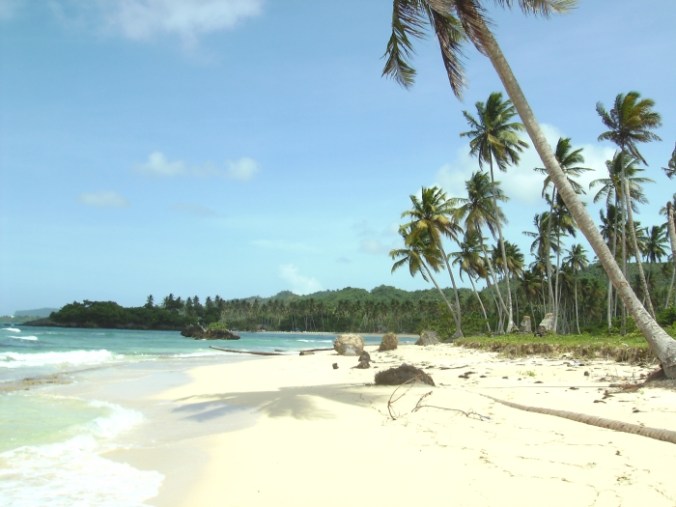
First of all: The Dominican Republic is a beautiful country. Stunning white beaches make way for black and ragged volcanic cliffs.  Dense, green junge drops away to reveal the bleached bones of the earth. Little islands, full of palm trees and pelicans rise from the sea, on them painted caves hint of civilizations long gone.
t

I have never even been near a tropical rainforest in my life and I found the experience absolutely amazing. The beaches were less impressive to me; being married to a Greek person does that to you. I have been to that country a few times and know what a pretty beach looks like, but even the husband, who is a bit jaded when it comes to beaches, had to admit that the Dominican ones were exceptionally beautiful. And despite the poverty I have to say that I was entranced with the colourful buildings. Even a little shack made from corrugated iron, or as the Wikipedia informs me, pailing in the local lingo, tends to be painted beautifully. Blue and yellow, green and pink, orange and purple. They look like rusted gemstones.

The poverty, however, is quite shocking. And it is everywhere, not only in rural areas. Families of four or five live in little shacks, made from pailing or roughly sawn boards, mostly with only one or two rooms. There are windows, but no glass. Dirt floors too, I suspect, although I never got a closer look at one of these. In the region where we were based, the peninsula of Samana, most towns aren’t even connected to the water supply network. (Just spend ten minutes searching the net for the proper term, why doesn’t the English laguage have a nice, short word for that? Even the Germans managed, and German is a bitch.) One day we were driving out of town in a minibus when the driver, a man introduced to us as only as Robinson, pulled over in front of a little shack: corrugated iron, no more than 50 square meters, lots of trash out front. Out run two little girls and the elder one gives him something through the open car window, a wallet, I think.  I can only assume her to be his daughter and this to be his house. Now Robinson works in the tourist industry, he has a steady job that pays even during the off-season, and he has to live in a tiny, rundown house on the outer edge of town. That’s when it really hit me how poor these people are.

Makes you feel bad about going to a place like that. At least we always gave good tips, except to our terror of a maid, who really didn’t deserve one.

Moving on from the depressing stuff.

The hotel was decent. Paradisal grounds and nice buildings. Three restaurants, three pools (which we didn’t use, the ocean was a hundred meters away, for crying out loud), a lake with turtles and a massage therapist, palm trees everywhere. The spacious rooms were in small, two-story buildings, which helped make the place feel less crowded and less, well, huge. What more do you want?

Well… A bathroom ceiling that doesn’t leak as soon as the horizon smells a little like rain. That would be something. Not having to be afraid of the maid. Also nice. Water that doesn’t taste of some unspeakable chemical compound. All these and more would be nice. I’m sure Jonas would also have liked a little more variety in the food. And chocolate cake. Me? I’m an omnivore, I eat anything, but even I have to say that the restaurant food could have been a bit more varied.

Now, I don’t want to sound as if the honeymoon was a complete nightmare. Because it wasn’t.

We went to the national park Los Haitises, which was beautiful. We saw the Cayo Levantado, the famed “Bacardi Island”, a place straight from a glossy travel magazine (or from a TV-spot for Bacardi, thus the name). We went snorkeling and saw giant starfish. I sat on a horse again for the first time in nearly ten years and I went up a path on said horse that no horse should ever have had to navigate. Genetically modified gecko-goat-crossbreeds maybe, but no horses. We bathed underneath a waterfall. I drank a cocktail out of a hacked-open coconut. We went sailing on a catamaran and we went to the longest beach on Samana in a tiny fisherboat. We saw turtles and dolphins, parrots and ostriches, lizards and iguanas, hermit crabs and starfish. And I managed to write a complete, shiny new outline for my next novel. How much more can you ask for on a honeymoon? Non-drippy ceiling, yes, I know. But in the end the good far outweighs the bad.

t

All in all I would love to see more of that region. Of the Caribbean in general, but also of the Dominican Republic. Seeing more of the densely vegetated inland areas. The national parks, as long as they are still there. The whales in winter, ditto on the as long as they’re still there.

Not going as an all-inclusive tourist would be a plus. Not only because I suspect that these AI hotels cut costs wherever they can and that that badly influenced the quality of the food and drink available, but also because the compulsory AI wristbands mark you out as a gullible tourist for all the world to see.

Learning some Spanish would be good too, because our non-existent grasp of the language often had us in bad situations with people who had a non-existent grasp of any language other than Spanish. With some that just lead to a lot of smiling and pointing, others, the ones a lot more oriented towards making a quick buck, just kept on talking in the hope that we would buy to make them shut up. Both situations were uncomfortable, albeit to varying degrees.

Enterprising locals are a big obstacle to enjoying the Dominican Republic. Not only are they intent on ripping you off, they also try to rip each other off whenever they can. On our trip to the Playa de Rincón, the one in a little fisherboat, we got badly ripped off. We didn’t mind too much, since we were too lazy to haggle and knew that we couldn’t take the money home, couldn’t change it back to Euros and would be going home on the next day. But then the man with whom we had negotiated the trip asked us not to tell the captain of the boat how much we had payed, probably so that he wouldn’t ask for a higher cut. Stuff like that makes me uncomfortable. I don’t like lying and I like lying for strangers even less. Luckily there were other people who managed to balance behaviour like that out. Like Rosy the cafeteria owner or the nice girl from the seafood a la carte restaurant.

But I digress, I was going to wrap this post up.

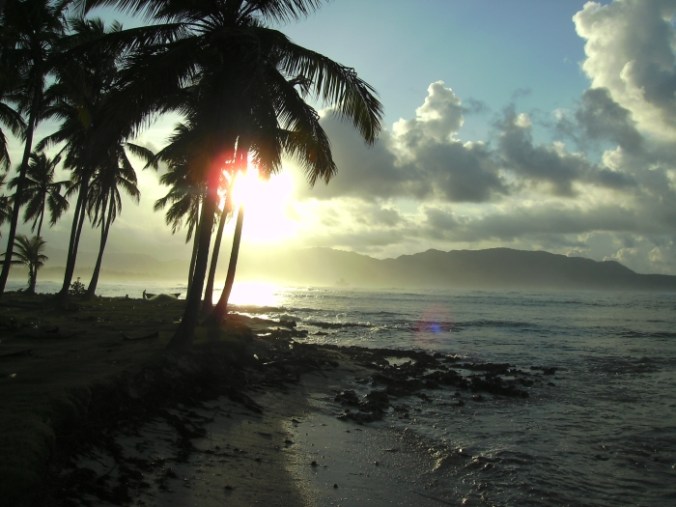
We had a good time in the Dominican Republic. We went to a country that we had never been to, in a region of the world that we had never been too. We ate foods that we had never eaten before. Saw beautiful landscapes and lots of exotic animals. That is pretty much my definition of a good holiday. Of a good honeymoon too, incidentally. The rest, the bathroom, the maid, the French, that’s all background noise. It annoys you if you concentrate on it, like when you try to sleep and aren’t quite tired enough to ignore the humming of the fridge in the next room, but all in all it stays where it belongs, in the background. And the rest is sunshine and beaches and lizards.
t

Hola

So… we’re back from our honeymoon.

Got back home around two-thirty and since then I’ve been trying to do everything in my power to stay awake, reasoning that giving in to the sweet temptation of sleep will only lead to a major case of jetlag. The result is that it now is three in the morning and I’m still up, caught in a strange, feverish state between wide awake and undead, and I think I’ll wake up tomorrow somewhen in the late afternoon with one hell of a headache. I believe there’s a word for those symptoms. What’s-it-called-again? Ah… Jetlag.

Damn.

Anyway. I will write a nice long post-Dominican Republic post tomorrow as soon as I’ve regained consciousness. For now, have a picture of the happy couple on the beach.

h

Lunch at Rosy’s

The hotel food where we are staying is okay. Almost everything gets served as a buffet, so the emphasis is on stuff that can be kept warm for a long time. Chicken, fish, pork, beef in white wine or tomato sauce, noodles and a lot of rice and potatoes. Lots of bread fresh from the loaf. Salad. Different kinds of plain boiled vegetables. I especially like the boiled, fried or pureed plantains, both green and yellow. And the yuca. And the pineapple. And…

You get my drift. Hotel food is decent. After a week of it one notices certain recurring patterns in what gets served when. Jonas is still hoping to run into that chocolate cake that we had on Monday. (My heart is lost to Saturday’s cheesecake. Damn you Mr. Pastry-Chef, there is too much variety. The cakes aren’t respawning fast enough!)

Today we sought to escape the routine of three buffet meals a day and took a walk into town. The village Las Galeras is, according to the hotel, about a mile away, which translates into a ten minute walk (fifteen on the way there, because we took a huge detour).
We had driven through the town twice so far, once on Friday when we arrived here in the dark of night and once on Sunday, on our way to the national preserve Los Haitises.
We hadn’t quite realised that when the travel book says small village it means small village. Personally I had taken it for a euphemism meaning tourist infested town ten heads short of a major city. I was quite wrong. Apparently all there is to Las Galeras is the one street and five hotels of varying sizes.
Not that what there is is bad, mind you.

The harbor had about ten boats, each sporting an enterprising young owner, eager to take us to one of the nearby travel magazine centerfold beaches for a small fee. Maybe tomorrow.
Moving on, one comes to the restaurant and hotel part of main street. Pardon, THE street.
Five or six restaurants snuggle up to each other: Pizzarias, French, Local Cuisine and the obligatory tourist trap, to which I am immediately drawn. Trust me to find the most kitschy place in a ten kilometer radius. Jonas saves me, we move on.
The second third of the street belongs to the gift shops: Spice Island, Tribal Fany (Not kidding) and half a dozen others. They invariably carry a selection of colourful paintings, wooden carvings of turtles, fish and other sea creatures. Ash trays. Coffee mugs. Key chains. Postcards. T-Shirts (my daughter went to the Dominican Republic and all I got was this lousy T-Shirt). Diving equipment. The usual.
After that the road slowly transforms into a residential area, with one or two mini-marts nestled in between the houses. Here, at the border between Tourist Land and the Dominican Republic we find Rosy’s Cafeteria. Her husband, whose name escapes me at the moment, runs an office selling day trips next to it. We were maybe going to eat here, the locals at the plastic tables seem healthy, so how bad can it be, but Rosy’s husband is the one who makes us stay.
German? English? Francais? He asks us. English we say, but he already has us down as Germans.
Would you like to go to Los Haitises? He asks in German. Before we can answer that we already have booked thee day trips with another angency he also offers us quad rides, the waterfall Salto de Limón and a catamaran trip. He doesn’t seem to be very disappointed that we are not buying. There is a French couple with him who might, however. His wife has very good food he calls to us as he strolls off with the French. How can we refuse?
Rosy is a short plump woman in a peach-coloured top and blue jeans, her hair neatly braided. Rosy’s Cafeteria is a small shack, painted bright yellow and dark blue, like her husband’s office. The kitchen is an even smaller shack made from rusty iron plates directly behind it. We get to see the kitchen when our extremely limited Spanish renders the food-negotiations hopeless. Hands and feet are not enough, we need to be shown the real thing. There are flies everywhere. The floor is packed dirt. We can have rice and salad with either chicken, lamb, fish or, I assume, beef. Everything is steeped in a deep brown thick sauce. We are hesitant at first, because of the flies mainly, but finally decide on the chicken.

In front of the cafeteria, in the shade of two trees and a large blue tarpaulin, stand six white plastic tables. We sit down on the one the furthest away from the shack, hoping that no one thinks that we are afraid of the flies.
A young woman brings us our food. Maybe Rosy’s daughter. Her sister more like, Rosy seems too young, the girl too old.
Two big plates of rice with beans and pumpkin. Has the thing with the chicken got through? Yes, here it comes: two small bowls full of chicken thighs and sauce. And a plate of salad with tomato and avocado.
It looks good. It tastes even better. We immediately forget all about the kitchen. The chicken is juicy and tender. The rice is nicely seasoned, I think I detect some cinnamon. And the avocado is the best we’ve ever had.
Halfway through out meal Rosy’s husband sits down next to us. The French have left, I think they were buyers.
The Husband is in a good mood. He has lived fifteen years in Munich, he says. Working for half a dozen different travel agencies. Tui. Schauinsland. Neckerman. You name it. But the Dominican Republic is better, not as cold. We agree.
He owns his own business now, which is better too, but summer is the off-season. No whales, business is slow. Good for the tourists, bad for him. Again we agree.
He likes Samana best, not only because he lives here, it is also less tourist infested. I sense a bit of a contradiction there, but he explains. When he moved back to the Dominican Republic, after Munich, he lived in Las Terrenas. Beautiful town, he says, but too many tourists. He was in a movie. Klinik unter Palmen, Hospital beneath palm-trees. German production. Harald Junke and someone else, I forget. Man, can the Germans drink, he says. I can imagine, I think. Two liters of rum a day. The strong kind; 75% alcohol. Wow, I think, now that I didn’t imagine. Still, since then Las Terrenas seems to be overrun be the Germans. We are glad that we are here, in Las Galeras. The man next door leaves his house. He says goodbye to our host. He’s Swiss, says Rosy’s husband in a low voice, very strange accent. He touches his throat, makes a strangling motion. We agree. The Swiss talk funny.

Rosy’s husband moves on to speak with some of his friends. Soon our lunch is finished. We pay 340 pesos. That’s less than seven euros. Ten dollars. And that included drinkies. Rosy seems pleased when we tell her that is was muy bien. Very good. It’s not a lie.
We are a little sad that we didn’t book our day trips with Rosy’s husband. Maybe another time. It would be good to see the whales.