
I don’t know what “Uva” means. I think it might be Spanish for disgusting. If it isn’t, it ought to be.
I looked it up.
Turns out it means grape.
Mhm… who would have thought.
I don’t know what “Uva” means. I think it might be Spanish for disgusting. If it isn’t, it ought to be.
I looked it up.
Turns out it means grape.
Mhm… who would have thought.
The green thing that I had for dinner tonight was green. And also orange. That should have made me suspicious.
It had the consistency of jelly, but no jelly I know should be that opaque. It had the shape of a slice of cake, but no cake should taste like that.
“Taste like what?” You may ask.
I’m sensory-impaired in that respect. I often can’t tell what is what.
In this case I did not want to know.
I wanted to take a picture, but I was afraid that the lens of my camera would burst. Some colours aren’t meant to be together, I suppose.
Let it suffice to say that it was green and it was orange and it was vile.
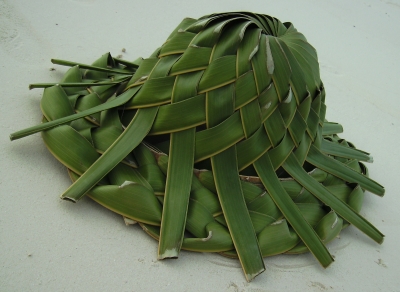
My green banana-leaf hat is wonderful.
It is made from one single banana-leaf, at least as far as I can tell. Wonderful in its simplicity.
It is wonderfully green, although it probably won’t be much longer, but that is okay too. It is organic, after all.
It provides shade; more shade than a baseball cap, less than a straw sombrero. That is also quite wonderful.
It proclaims me to be a tourist for all to see and even if that is not wonderful I coulnd’t care less, because I love my green banana-leaf hat.
Another Irving book. I swore not to read any more after Until I Find You. Needless to say that I didn’t like that one very much. I find that some of Irving’s books (not all of them… wait, yes, actually all of them) are just an exercise in collecting weird characters with weird jobs and weird fetishes. It’s okay, if you do it right, after all I loved The World According to Garp, and the people in that one are about as cockoo as you can get, but sometimes it just gets in the way of the story. Like in The Hotel New Hampshire.
Now, to be fair, it is a lot better than Until I Find You, where I had to restrain myself from making a lot of black and white confetti fifty pages in. (I read the whole book in the end, god knows how I managed AND stayed sane. It doesn’t get better. Not. One. Jot.)
The Hotel New Hampshire seems to constantly be balanceing between falling off the edge of a very high cliff with spiky rocks at the bottom, pulled by the weight of cliché accumulated by its characters and staying on top of the ridge, anchored there by Sorrow. (If you read the book you’ll know what I mean. Almost all the beautiful scenes in the book are connected to Sorrow. Sorrow and State-of-Maine.)
And the book actually has many good things about it. Old friends die heroically. Parents seem to regress into children. Dwarfs try to grow. Rapists get raped. Bears transform into humans. And most of all, one of the most prominent sentiments in the book: Sorrow floats.
I’m built close to the water, as we say in Germany, meaning that it is easy to move me to tears, but even I found that the ending of The Hotel New Hampshire was extraordinarily touching.
Now imagine that I found it extraordinairily touching DESPITE all the crap that the reader is made to swallow before that.
Irving loves his wacky characters. And he loves to have a lot of them. In the last two books that I read this almost made me swear off Irving forever.
And in the Hotel? Well, it’s pretty thick. Whores, radicals, communists, radical communists, bombs, opera, circuses, dwarfs, pet-bears, fake-bears, fake orgasms, lesbians and gays, rapists, weight-lifters, stuffed dogs, plane crashes, hostages, day-dreamers, more rape victims than you care to count: You name it, the hotel got it.
It’s just a little too much. It suffocates the story at times. At other times you will just put the book down and ask: why am I doing this to myself?
Me? Well, I’m a bit of a masochist when it comes to books. Finish what you start, is my first commandment. I tend to think that things will get better, just after the next page. Often they don’t. Often I know that. I those cases I at least want to be able to make an informed decision on how bad the book in question is. This lamentable habit has cost me quite a few precious hours over the years. The only book I ever put down I regret having done so, The Stand by Stephen King, but that’s nothing that can’t be remedied.
Anyway, the bottom line is that despite all the sex, and the rape and the general nauseating over-the-top-ness of The Hotel New Hampshire I am very happy that I did not put it down. At least not for long.
Hope floats too, I guess.
The hotel food where we are staying is okay. Almost everything gets served as a buffet, so the emphasis is on stuff that can be kept warm for a long time. Chicken, fish, pork, beef in white wine or tomato sauce, noodles and a lot of rice and potatoes. Lots of bread fresh from the loaf. Salad. Different kinds of plain boiled vegetables. I especially like the boiled, fried or pureed plantains, both green and yellow. And the yuca. And the pineapple. And…
You get my drift. Hotel food is decent. After a week of it one notices certain recurring patterns in what gets served when. Jonas is still hoping to run into that chocolate cake that we had on Monday. (My heart is lost to Saturday’s cheesecake. Damn you Mr. Pastry-Chef, there is too much variety. The cakes aren’t respawning fast enough!)
Today we sought to escape the routine of three buffet meals a day and took a walk into town. The village Las Galeras is, according to the hotel, about a mile away, which translates into a ten minute walk (fifteen on the way there, because we took a huge detour).
We had driven through the town twice so far, once on Friday when we arrived here in the dark of night and once on Sunday, on our way to the national preserve Los Haitises.
We hadn’t quite realised that when the travel book says small village it means small village. Personally I had taken it for a euphemism meaning tourist infested town ten heads short of a major city. I was quite wrong. Apparently all there is to Las Galeras is the one street and five hotels of varying sizes.
Not that what there is is bad, mind you.
The harbor had about ten boats, each sporting an enterprising young owner, eager to take us to one of the nearby travel magazine centerfold beaches for a small fee. Maybe tomorrow.
Moving on, one comes to the restaurant and hotel part of main street. Pardon, THE street.
Five or six restaurants snuggle up to each other: Pizzarias, French, Local Cuisine and the obligatory tourist trap, to which I am immediately drawn. Trust me to find the most kitschy place in a ten kilometer radius. Jonas saves me, we move on.
The second third of the street belongs to the gift shops: Spice Island, Tribal Fany (Not kidding) and half a dozen others. They invariably carry a selection of colourful paintings, wooden carvings of turtles, fish and other sea creatures. Ash trays. Coffee mugs. Key chains. Postcards. T-Shirts (my daughter went to the Dominican Republic and all I got was this lousy T-Shirt). Diving equipment. The usual.
After that the road slowly transforms into a residential area, with one or two mini-marts nestled in between the houses. Here, at the border between Tourist Land and the Dominican Republic we find Rosy’s Cafeteria. Her husband, whose name escapes me at the moment, runs an office selling day trips next to it. We were maybe going to eat here, the locals at the plastic tables seem healthy, so how bad can it be, but Rosy’s husband is the one who makes us stay.
German? English? Francais? He asks us. English we say, but he already has us down as Germans.
Would you like to go to Los Haitises? He asks in German. Before we can answer that we already have booked thee day trips with another angency he also offers us quad rides, the waterfall Salto de Limón and a catamaran trip. He doesn’t seem to be very disappointed that we are not buying. There is a French couple with him who might, however. His wife has very good food he calls to us as he strolls off with the French. How can we refuse?
Rosy is a short plump woman in a peach-coloured top and blue jeans, her hair neatly braided. Rosy’s Cafeteria is a small shack, painted bright yellow and dark blue, like her husband’s office. The kitchen is an even smaller shack made from rusty iron plates directly behind it. We get to see the kitchen when our extremely limited Spanish renders the food-negotiations hopeless. Hands and feet are not enough, we need to be shown the real thing. There are flies everywhere. The floor is packed dirt. We can have rice and salad with either chicken, lamb, fish or, I assume, beef. Everything is steeped in a deep brown thick sauce. We are hesitant at first, because of the flies mainly, but finally decide on the chicken.
In front of the cafeteria, in the shade of two trees and a large blue tarpaulin, stand six white plastic tables. We sit down on the one the furthest away from the shack, hoping that no one thinks that we are afraid of the flies.
A young woman brings us our food. Maybe Rosy’s daughter. Her sister more like, Rosy seems too young, the girl too old.
Two big plates of rice with beans and pumpkin. Has the thing with the chicken got through? Yes, here it comes: two small bowls full of chicken thighs and sauce. And a plate of salad with tomato and avocado.
It looks good. It tastes even better. We immediately forget all about the kitchen. The chicken is juicy and tender. The rice is nicely seasoned, I think I detect some cinnamon. And the avocado is the best we’ve ever had.
Halfway through out meal Rosy’s husband sits down next to us. The French have left, I think they were buyers.
The Husband is in a good mood. He has lived fifteen years in Munich, he says. Working for half a dozen different travel agencies. Tui. Schauinsland. Neckerman. You name it. But the Dominican Republic is better, not as cold. We agree.
He owns his own business now, which is better too, but summer is the off-season. No whales, business is slow. Good for the tourists, bad for him. Again we agree.
He likes Samana best, not only because he lives here, it is also less tourist infested. I sense a bit of a contradiction there, but he explains. When he moved back to the Dominican Republic, after Munich, he lived in Las Terrenas. Beautiful town, he says, but too many tourists. He was in a movie. Klinik unter Palmen, Hospital beneath palm-trees. German production. Harald Junke and someone else, I forget. Man, can the Germans drink, he says. I can imagine, I think. Two liters of rum a day. The strong kind; 75% alcohol. Wow, I think, now that I didn’t imagine. Still, since then Las Terrenas seems to be overrun be the Germans. We are glad that we are here, in Las Galeras. The man next door leaves his house. He says goodbye to our host. He’s Swiss, says Rosy’s husband in a low voice, very strange accent. He touches his throat, makes a strangling motion. We agree. The Swiss talk funny.
Rosy’s husband moves on to speak with some of his friends. Soon our lunch is finished. We pay 340 pesos. That’s less than seven euros. Ten dollars. And that included drinkies. Rosy seems pleased when we tell her that is was muy bien. Very good. It’s not a lie.
We are a little sad that we didn’t book our day trips with Rosy’s husband. Maybe another time. It would be good to see the whales.
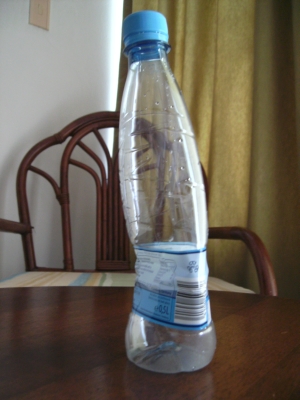
This is a water bottle that was emptied and closed at an altitude of 32000 feet. (I might be completely wrong about this, I’m not good at remembering numbers. Let’s just say at whatever altitude commercial airliners cross the Atlantic Ocean.) This is what it looked like after landing. That’s atmospheric pressure for you, baby!
So… here we are: The Dominican Republic.
Looks like Greece only with more water.
Yesterday was a day full of ups and downs, and if I say that I mean really high up and very very far down. We spent the day with packing, advance blogging and discovering that my passport had expired. Fun fun fun. The problem was eventually fixed with a provisionary passport (that now has my new name on it, yay!) and we were only sixty minutes too late for out flight (which was really cool, seeing that we got bumped to first class, double yay!).
Arrived here at seven thirty local time, made it out of the airport by eight thirty,and got to the hotel way past midnight and several near-death experiences later. The guy at the travel agency wasn’t joking when he said that they don’t really know about driving safely here.
Which reminds me: Scary fact, we booked our vacation from a guy who resembled Ben Linus of Lost to a rather unsettling degree (if I follow that thought through I have to admit that he didn’t try to convince us to kill anyone, so maybe it wasn’t Ben after all).
The Hotel is pretty, although our bathroom ceiling drips and plumbing is an unknown concept, but the beach… the beach…

Also we found a baby turtle.
First of all: Yes, I know, I am much funnier when I dislike stuff. Everyone is.
And: Yes, I promise to read something crappy next. (Chances are good; I’m currently reading a book by John Irving, who might be a good author if he didn’t obsess about sex that much.)
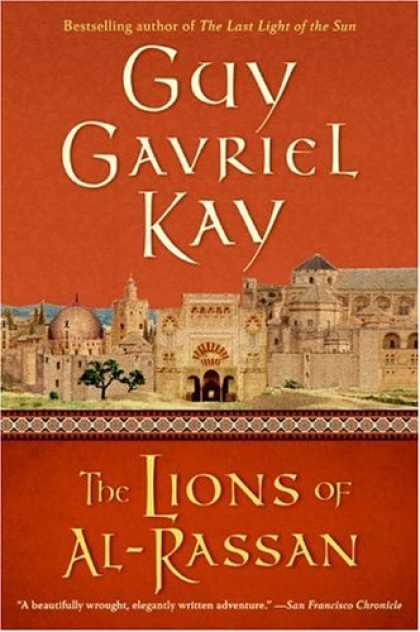
So: Sorry, but The Lions of Al-Rassan by Guy Gavriel Kay is one of the most excellent novels that I have read in, well, a long time.
Besides that there really is not much to say. The book follows multiple point-of-view characters, each of them real and likeable enough to adopt in a heartbeat. The setting is medieval Spain, or what medieval Spain might have looked like had things gone a little different, but just a little, mind you. The story is powerful, passionate and mesmerizing, something I haven’t experienced to such a degree since… let me think… The Dark Tower, I’d say. Completely different type of storytelling, but both sweep you off your feet.
My husband read Tigana (also by Guy Gavriel Kay) recently and had a similar experience. So yay for Kay. And that must be true, because it rhymes.
(Do not continue reading if you want to keep your respect for me as a professional geek, but) the book also features one hell of a love story. I can’t help it, I’m a girl, don’t hold it against me.
So the bottom line is this: Read this book if you love good fantasy/alternate history with strong characters and really really excellent writting. The Lions of Al-Rassan was really a bit of an eye-opener to me in that respect, seeing that in the past I tended to look down on alternate history stories as the refuge of post-menopause women with boring jobs. My bad.

Note: Jonas and I are playing this game together, even though it’s a single-player game. You can read his review here.
Besides reading a lot and going to the movies a lot I also play computer games… a lot. Only recently there has been an appalling drought in the genre of first or third person RPGs. The good kind. Not the kind from Japan, with half-naked twelve year old girls called Simon as protagonists.
So, along comes Divinty II: Ego Draconis. In terms of graphics it looks a lot like Gothic 3, which made me nervous at first, because Gothic 3 was an appalling pile of moose dung. (I shall pretend to be a software-geek for a moment and say that Divinity II is actually done in the same engine as Oblivion and Fallout 3, but fails to look as good as either. Not that it looks bad, mind you.)
Now, after playing the game for about fifteen hours twenty hours way too long (considering we only bought it on Thursday), I have to say: Fear not, it be great fun.
The world is big and open, although you quickly notice when you’ve strayed too far for your current level. (I mean that as a compliment, Oblivion has taught me to fear games with leveling enemies. If I never see a level 40 Xivilai again I’ll die a happy woman.) The fighting system is simple, too simple, I might even say, as there is little variation to the attacks that you can choose from, especially at the beginning. The story is adequate, although nowhere near as good as, say, Gothic 1 and 2. And best of all: You can turn into a dragon. Not at first, and I have to admit that I haven’t gotten there yet, but hey, you can turn into a bloody dragon. So shut up and don’t complain.
Advancing your character stays hard throughout the game and especially at the beginning you’ll curse the absence of “good” weaponry. When you level the game isn’t too generous on the attribute and skill points, so I’d suggest to choose wisely what you raise and what not. If you think this is a bad thing you might do well to reconsider buying the game. Personally I think it is wonderful. There is nothing more refreshing as five minutes of agonized indecision as to where to put your next skill point. (I AM trying to be as un-sarcastic as possible here, I mean it.) Also it really makes you appreciate your first level 20 goblin chief and the 1000 xp that he brings along as a present.
The music is really awesome. Not awesome as in I need to listen to this even when I’m not currently playing, but awesome as in I frequently catch myself whistling the tavern theme when I’m preparing dinner. Which is a coincidence, actually, but these days I do little but play, cook and sleep, so the chances were pretty good.
The writing deserves praise as well. (For those of you that are wondering: we are playing the German version of the game, seeing that the English one only comes out in September.) Anyroad. I find that it takes a bit to make me laugh when it comes to computer games and this one has managed to do so on several occasions. So, yay for the writing. If I had to change anything I’d remove most of the meta-humour, since it tends to damage the immersion in the same way that a glowing-hot needle damages a soap bubble. But luckily the really gross examples of such “wit” are few and far inbetween.
Despite all my criticism Divinity II is deeply enjoyable. Not one of the greats, but a lot better than anything that has come along in recent years. For people who enjoy a good RPG with a plot that is a little more substantial than candy floss, witty dialogue and a nice big world to strech one’s avatar’s leg in I would definitely recommed this game. So go forth and kill some goblins and don’t miss out on making a creature from decayed body parts, that’s the best bit.
Edit: Here are my slightly more negative thoughts upon having finished the game. It’s still got many excellent parts, but…

Oh, yes.
Sorry.
Got a bit carried away there.
Where was I?
Barnacle Bill.
My Lucius Shepard experience so far has mostly been limited to short stories, and of those I have read a lot. Also, as mentioned above, two of these count among my favourite pieces of writing in the whole wide world. So naturally my expectations for Barnacle Bill were high. I am glad to say that I was not disappointed.
As with a lot of Shepard’s writing, I would not have minded for some of the stories to be longer. That is especially the case when it comes to the title story, where you only get a glimpse of what our world might look like in the future. It’s not pretty, but I’d like so see more.
As for the other stories: both A Little Night Music and Sports in America suffered from a certain blah-ness, but I suspect that is because I found the topics to be to my disliking. The writing is as always superb.
The Sun Spider is Shepard at his best. I don’t think anything will ever be able to eclipse the story about the sleeping dragon Griaule and Meric Cattanay the man who painted him, but this one comes close. Like Lem’s Solaris or the 2007 movie Sunshine by Danny Boyle and Alex Garland, this story manages to convey the sense of awe and wonder that I imagine has to beset one if confronted with something as mind-boggling as the sun or, as in Lem, a creature too alien to comprehend.
We are taken to Egypt in All the Perfumes of Araby and from there on towards Israel. A setting that made me pause, given the current political situation in that region. The story is twenty years old, true, but from my viewpoint not much has changed in that time, so what would Shepard’s take be? Surreal, is the answer. And once again too short. The story seems to end when the protagonist’s journey is just beginning. If you ever read this, Mr. Shepard, personally I wouldn’t mind reading a novel about Danny Shields. Just so you know.
Finally, maybe the most surprising story of the collection: Beast of the Heartland. I didn’t think much of it when I started reading the story. Actually I was sorely tempted to put the book aside at this point, only that’s against my honour as a reader. The problem was that I could once again tell that this was a subject that didn’t draw me much. Now, after reading the story, I am very grateful that I did read on, because this story about a washed-out boxer is amazing. It’s not too long and not too short, sad and joyful at the same time and full of mesmerizing imagery.
All in all Barnacle Bill the Spacer is a thoroughly satisfying read, although I would recommend the more recent Eternity and Other Stories to first-time Lucius Shepard readers. But then again, if you want to get really hooked read The Man Who Painted the Dragon Griaule, now there’s a story…
 Verena Kyratzes