What Happend in 2012 and What Will Happen in 2013

As Jonas has said over on his blog, 2012 has been a turbulent year. Difficult, but also hugely rewarding.

This post was supposed to be about what we did in 2012 and, more importantly, which creative projects lie before us in 2013, but as I sit here and try writing that post I become aware of something that needs to be written first.

I had an accident in May 2012. I haven’t written about the incident on this blog, but this will come as no surprise to those of you who read Jonas’s blog regularly.

The accident itself has left little in the way of permanent physical scars. I have a patch of pink skin on my shoulder that will probably never tan again and a smallish scar above my right eyebrow. It will remain visible for the rest of my life, but as the months pass I’ve more of less gotten used to the sight.

What’s more shocking are the psychological scars. I’ve always been someone who just got back on the horse after falling off. I believe, firmly, that since the past happens to be unchangeable it’s no bloody use lamenting it. What’s done is done. The accident was maybe the first time in my life where I played the “what if”-game to exhaustion. What if I’d gotten out of the house earlier that day? What if I hadn’t ironed the blouse that I wore? What if it had rained? What if I had stopped at the bakery for a bun? And all it did was depress me, deeply, because “what if” could never happen.

Depression didn’t end there. Self-pity aside, and there was a lot of self-pity in those early weeks, there was also the enormous injustice of it all to deal with. Not only is the German legal system heavily weighed against the poor (doubly so against the non-motorized poor), I was also faced with a more criminal kind of injustice. There was, suddenly, a witness to the accident that was willing to testify against me. I was supposed to have crossed the intersection in the red. This wasn’t only infuriating because it is a lie, but also because walking/driving across a red light is a personal pet peeve of mine. In my life I’ve maybe crossed a handful of intersections in the red. All as a pedestrian, which doesn’t make it any less wrong, this is just to illustrate that I remember these incidents because they bother me. The latest one, ironically, was just two weeks after the accident, when I was so distraught over the whole wittness-appears-out-of-nowhere-thing that I crossed a street without looking. To make matters worse, the first police officer that I spoke to seemed to be convinced that I was guilty. He, a life-long car-driver, seemed actually convinced that cyclists should be shot on sight. Would you like a helping of injustice with your injustice? My mother once told me that she feels ashamed, bordering on angry, when she goes grocery shopping and the cashier asks her to lift her shopping basket from the cart to see if there’s stuff hidden underneath – I fear I’ve inherited the same impulse. Only the cashier from the story is probably only following orders whereas what I was experiencing was downright malice.

(The “witness”, incidentally, only contacted the police via the phone and could never be reached again. It’s no longer a problem.)

I apologize for rambling. I suspect that I could keep talking and writing about the accident, adding detail upon detail, and I still wouldn’t have recounted all the things that made me depressed in the weeks and months that followed. What of my bicycle, for example? I loved that bike. It was old and worn, but if I could save one object from our burning house (cats and husbands are not objects!) I would have picked that bike. (It’s a thought experiment I sometimes make… don’t ask.) The bike is trash now. The fork burst in the impact, the frame has micro-fractures. It’s very uncertain if I’ll ever see any money for that. What of the taxi driver? I never thought I was vengeful, but if he never gets behind the wheel of a car again… well, that would be something, wouldn’t it? Won’t happen though. All praise the German legal system.

Rambling. Again. Sorry. The point is that I was very depressed. So depressed that at times I would do nothing but weep for hours. I lost my creativity. Everything seemed pointless. If something like that can happen, what point is there in attempting to create something? Jonas did his best to help. And he did. He was my rock. He was relentlessly positive. Wouldn’t let me depressed, no matter what. He took care of me when I felt too miserable to leave the house. He was, maybe the biggest balm of all, outraged and fuming at each new, horrible turn that the whole affair took. His own creativity suffered, and for him being uncreative is intolerable, but he wouldn’t give up. But sometimes it wasn’t enough. And so, for months and months on end, I vegetated. I only left the house to go to work, avoided meeting friends and family whenever I could.

It improved when we went to Greece in September, but my creativity still was AWOL.

The funny thing is that I don’t quite know how it came back. I know when, though. One week in late November we were talking about making a new Lands of Dream game, maybe in time for Christmas (haha) and there it was. Suddenly I was drawing again. It was as if something inside me suddenly said “now, now, young lady, that’s enough moping, let’s do something.”

Not writing, not yet. The thing that really stopped me from blogging, besides the fact that everything seemed just too much effort in post-accident-life, was that I knew that I would have to write about the scars at some point. I started writing that article a dozen times, and never finished. Not only did it depress me, I also was never happy with what I said. I’m not happy with this post either, but I think I’ve finally understood that it just needs to get out. Capturing the accident in writing seems to rob the beast of some of its strength.

When I started this was supposed to be a post about what a great creative year 2013 was going to be and this is now how I’ll end this post. Jonas recently wrote a short overview of what he is going to be doing in 2013 and I’ll be involved in some of these projects, so you might want to have a look at that.

Besides that I will try to focus on getting back on top of writing things. Not only blogging, that goes without saying, but also short stories and my novel (which is still, sadly, in need of editing). Maybe even a screenplay or two. I always, foremost of all, wanted to be a writer. Drawing, painting and cooking is all very well, but writing is what I need to do.

Speaking of drawing… there will be at least one Lands of Dream game in 2013, maybe even more than one. And painting. Lots of painting. We’ll re-open the Compendium soon, and I’ll also try to get some sort of exhibition space for my acrylic-on-canvas Lands of Dream paintings. Or a way of selling them. Or both. But definitely something.

And finally there will also be lots of cooking in 2013. I have dozens of recipes that I want to share and a dozen more that I want to try out. This obviously also involves doing more episodes of The Starving Artists Kitchen.

So yes, 2013 is going to be great.
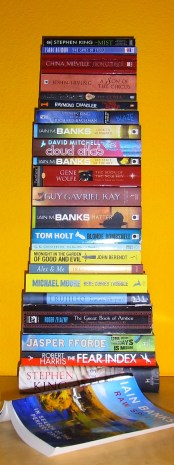
2012 Reading List

Now in chronological order:

Trumps of Doom – Roger ZelaznyLots of Books
Blood of Amber – Roger Zelazny
Sign of Chaos – Roger Zelazny
Knight of Shadows – Roger Zelazny
Prince of Chaos – Roger Zelazny
The Last Light of the Sun – Guy Gavriel Kay
Look to Windward – Iain M. Banks
Here Comes Trouble – Michael Moore
The High King’s Tomb – Kristen Britain
22-11-63 – Stephen King
Trujillo – Lucius Shepard
Midnight in the Garden of Good and Evil – John Berendt
The Fear Index – Robert Harris
Solar – Ian McEwan
Matter – Iain M. Banks
Blonde Bombshell – Tom Holt
The Cold Moon – Jeffrey Deaver
A Bend in the Road – Nicholas Sparks
The Shadow of the Torturer – Gene Wolfe
The Claw of the Conciliator – Gene Wolfe
The Sword of the Lictor – Gene Wolfe
The Citadel of the Autarch – Gene Wolfe
The Big Sleep – Raymond Chandler
Iron Council – China Miéville
One of our Thursdays is Missing – Jasper Fforde
A Son of the Circus – John Irving
The Mist – Stephen King
The State of the Art – Iain M. Banks
Blaze – Richard Bachman
Alex & Me – Irene M. Pepperberg
The Coma – Alex Garland
Cloud Atlas – David Mitchell
The Caves of Steel – Isaac Asimov
The Man Who Was Thursday – G. K. Chesterton
Raw Spirit – Iain Banks

2012 was a highly varied reading year. As always I’m far below the number of books that I wanted to read, but I guess the times when I was an unmarried, jobless, friendless, carefree gal of 15 who didn’t generally bother with homework won’t be coming back. Good riddance, I say. If I had to pick my favourite book of the year I would have to say Look to Windward by the always amazing Iain M. Banks, with The Coma by Alex Garland a close second.

Worst book of the year is a little harder to pick. The competition is so thick that you could cut it with a chainsaw… and probably should. I guess I should nominate A Son of the Circus by John Irving, just because everyone keeps carrying on about how bloody brilliant his books are. Well, they aren’t, at least not all of them. Second place is a tie between Nicky Sparks and Jeff Deaver for brain-numbing, cliché-laden awfulness and abuse of the English language in general. And Kristen Britain… well… is Kristen Britain. See my review of First Rider’s Call for more details.

I also had a few firsts, authors which I’d been meaning to read since forever but never got around to, and those were one and all delightful. Chesterton, Zelazny, Wolfe, Chandler, Miéville and (I am ashamed to say) that giant of both fiction and non-fiction, Asimov, are all worth a read. Not a single turd there.

For now I’m still in the middle of Raw Spirit by Iain Banks, which I am enjoying way too much to be envious of someone who got paid to taste all of Scotland’s great single malt whiskies. Okay, maybe a little. But it’s a really great read. And I shall use it to bolster my next reading list – after all, I can legitimately claim that I read it in 2012 and 2013.

Teaser

New Game? You Bet!

Yes, we’re working on a new game. Or rather I’m working on a new game and Jonas is working on half a dozen other things and will catch up with me eventually. No, I can’t tell you what it is called yet. Yes, it will be awesome.

A Message From Cat

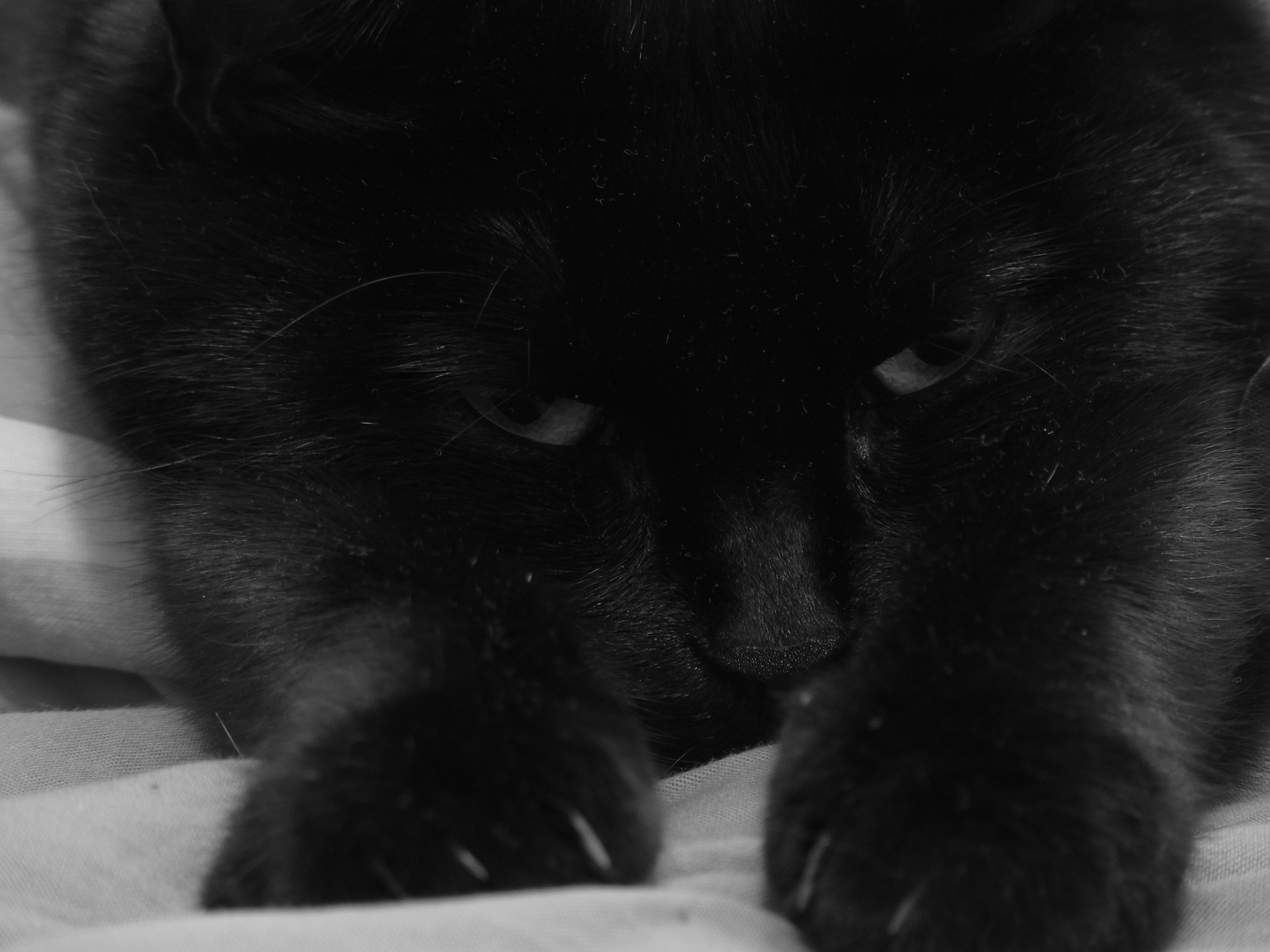
Cat, who hates the evil thing that makes noise and bright lights (ie: the camera), was too lazy to slink away when I started taking pictures yesterday. I thought that was very sweet of her. Doesn’t she look sweet? And not annoyed at all…

She’s told me that, in exchange for her services as a model, I should remind people that TSWCE is on special offer until Friday. Save 42% and make a cat happy.

What… you say you’ve already got a copy? Mhm… well, then go and get another. Or get one for a friend. Or a family member. Or that random person that you saw on the bus yesterday. No… not that one. The one that smelled of cheese. Think of it as a post-thanksgiving-pre-christmas-gift. Our cat overlords will be pleased with your purchase.

Art of the Present

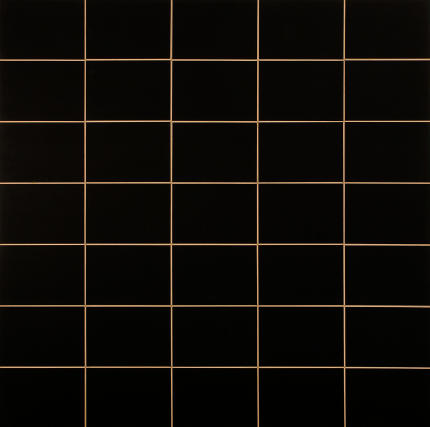
This work of art (I’m in a charitable mood) is called “Schwarze Tafeln”, which basically means “black panels”. And this object really is what it says on the box. There are five of these, they look absolutely identical and they’re simply cardboard squares stuck onto big metal frames. And I hate them. They symbolize all that is wrong with modern art. We saw these things when we went to the Frankfurt museum of art, the Städel, the other day. They’re the work of a Frankfurt-based artist named Peter Roehr and they’re exhibited in a bright and shiny and simply humongous new wing of the Städel that deals with “Gegenwartskunst” (Art of the Present). And the sad thing, the really depressing thing, is that these weren’t even the worst things on display, but merely the ones that I can rant about the easiest. The artist,  who died in 1968, apparently said that this work is supposed to express the meaninglessness of modern art, but seriously, if you say that about your work you’re just not trying hard enough. You also don’t do another 599 pieces that express exactly the same. To be fair, if he had said that this piece symbolized child starvation in Uganda, I wouldn’t have bought it either.

I can’t quite fathom the mind of an artist like Peter Roehr. He died young. I shall refrain from any jokes, because he died of cancer, a fate that no one deserves. And yet, at the relatively tender age of 24, he managed to produce more than 600 works of art. Had a writer produced even one tenth of that in a full life with 40 good working years, many would call him a hack. Now, that may or may not be true, but what does it say about Peter, and his 600+ works? We seem to accept this number, even if accomplished in such a short time, much more readily when it comes to paintings. Yet no one ever seems to consider the assembly-line-esque conditions under which these works must have been created. Did Peter Roehr, or any of his ilk, really put any heart or effort into those works? Some say that anything is art, but I disagree. I like my art to be pretty; that’s a subjective statement, but on a more objective level I also like my art to mean something. Not “mean” as in “this painting is about child starvation in Uganda”, but as in something that took thought or effort or skill.

My viewpoint isn’t easily quantifiable. It is obviously silly to say that something that took ten minutes to make isn’t art, but something that took 10 minutes and one second is. But still. Peter Roehr was active as an artist from 1962 until his death in 1968. That makes, if one assumes a steady output of 600 works total, one object every 3 days. That’s an awful lot, I’d say. And as we’ve discussed above “it symbolises ze futility of art” doesn’t really cut it for me.

So what makes you tick, Peter? Greed? Maybe. I’m not sure. Some people need to have creative output, I get that. I don’t suspect my musings on the subject will get me anywhere, at least not anytime soon. If there’s an afterlife I’ll pop the question to Peter in a few decades or so. I hope he has a satisfying answer. Until then I remain vaguely puzzled at the mystery of Peter Roehr and why people seem to think his “Schwarze Tafeln” are the bee’s knees.

Slight change of subject: I’ve been thinking a lot about art lately, mostly because I’ve been wondering about ways to sell my own art. Am I too modest or too arrogant? How much is too much when it comes to the price? Peter was too arrogant, I’d say, but the opposite isn’t great either. I loved making the Compendium entries, and they helped us out of a terrible fix monetarily, but we sold them barely above what it cost us to produce them. What is the artistic value of these drawings outside of this highly specialized context? I have always felt (unlike my friend Peter, I assume) that it is hugely important to give value for money. The thought of overpricing my works is horrifying to me. The thought of somehow grossly overestimating their artistic worth even more so. No-one likes pretentiousness, least of all me. I erratically oscillate between self-doubt and confidence. To make it worse, I don’t only have to think about my own skill, but also about what other people will consider art. Judging from what we saw in the Städel… a whole lot, and not much of it looks like what I do.

Sigh. Another question with no easy answers.

What I was going to say, before I got hit by seven tons of self-doubt, is that I’ll also have a lovely, more general, article about modern art for you tomorrow. So be sure to check back!

No Bears But Lots of Beaver

So I’m reading A Son of the Circus by John Irving right now. I used to love Irving, but as I grow older (and have more Irving reading experience) my opinion of his books has shifted from “wow, this is some crazy imaginative shit” to “oh bother… another story about bears, midgets, rape and weird sexual disorders.” Irving is the Joseph Beuys of the writing world, and his fat and honey are bears and prostitutes. I suspect a lot of people feel that way. The rest probably haven’t been paying attention.

I have, at this point, read 30 pages of A Son of the Circus, and although the story hasn’t even properly begun yet, the book is already worthy of review.

The circus referred to in the title is an Indian circus, so this book’s ursine content is probably relatively low. As a matter of fact that’s the reason why I chose this novel over the other Irvings that are still loitering in our bookshelf, a low bear quota is always a plus. It’s got midgets, though. Let’s see how Irving will manage to annoy me with those.

For now I have two other bones to pick with this novel. One of them, the smaller bone, is that the book is set in India (a country in which Irving has spent under a month in his entire life) and has an Indian protagonist who was schooled in Austria (another Irving favourite) and lives in Canada. And like all good transcultural protagonists he’s uncomfortable in Canada, feels alienated in India, and is generally at odds with where he belongs and who he is. And while I’m sure that there are plenty of similar people out there, people who for one reason or another have left their country of origin and now have trouble settling down and adjusting to a foreign culture, I think that this has become such a cliché of modern writing that it should be outlawed. Ask anyone who’s studied English Lit with a focus on transcultural studies. If they’re clever they’ll tell you that you can’t poke a stick at a writers’ conference without hitting someone who’s written extensively and stereotypically about this subject. If they’re less clever they’ll tell you that Mr. Irving is writing the shocking truth about these poor, uprooted people.

But that’s a minor complaint. Here’s the bigger one:

The 30 pages of A Son of the Circus that I’ve read make up three chapters. The first one concerns itself with how wonderfully quirky and eccentric (with just the right dash of melancholic) our protagonist, Dr. Farrokh Daruwalla, is. And that’s okay. The second one briefly tells the story of Farrokh’s best friend, a dwarf, and how they met. Then, somewhat less briefly, it relates the story of how Farrokh once broke his nose on his best friend’s wife’s vagina while in a trapeze safety net. See what’s wrong with that? A lot, seems to be what comes to mind. And it gets better. Chapter three is all about Farrokh being at a private golf club and contemplating an image of the founder’s wife, Mrs. Duckworth. Mrs. D., now long deceased, apparently had a slight problem with exhibitionism. And Farrokh, his imagination now sufficiently fueled by this titillating bit of information, spends about five pages musing about the feel, bounciness and general aerodynamics of Mrs. Duckworth’s breasts. Now… see what’s wrong with that?

I’ll tell you. Why, for the love of all that’s good, do modern writers need to obsess about sex like that? I’m not a prude, really, but I find this fixation somewhat disturbing. What happened to good old “plot”? Rhetorical question, I fear. Plot’s out of fashion, because plot means talking about the world, and civilisation, and meaning. Maybe even politics (gasp!). So instead sex has become the written equivalent of what in theatre is “naked man and a projection”. It’s what once was new and daring, something to shock the elderly out of their stupor, and what’s now so commonplace that it has become the new establishment. Absurdly, sex has become safe, and plot has become something uncomfortable. This isn’t the first time I’ve noticed this, Solar by Ian McEwan had similar problems, but this morning while talking to Jonas I suddenly happened across the explanation. And I was astounded. It’s nothing but fear of plot. A story allergy. A postmodern disease, if you will. It permeates modern literature and sucks all meaning out of novels. I wonder what Freud would make of this.

Now, I’m not saying that A Son of the Circus isn’t still going to get around to having a little bit of plot, if there’s time between Farrokh thinking randy thoughts and all the embarrassing accidents that are bound to ensue, but I still think the absolute vacuum of meaning generated by these opening chapters is worth noting. I’ll continue reading, if only because I hate not finishing a book. Check back in a week or so to see how it went.

Death

My grandmother died today. Just like that. She wasn’t sick, not that anyone knew of anyhow. It just happened. One minute I’m calling my mom about meeting up later, the next minute mom calls me back to tell me that my gran just died.

I really don’t want to write anything about how it happened. Or when. Or who showed up to express their condolences and what they said. It really doesn’t matter. All that is family business and it doesn’t contribute anything to what kind of person she was. What I want to say, what matters to me now, is the following:

We weren’t close, to claim so would be hypocrisy. To say that I am grief-stricken would be false. I’m in mild shock. I still say “my grandparents” not “my granddad”. My brain hasn’t quite caught up with the present. But, at the end of the day, she was kind and she genuinely cared for her family. And the most surprising thing, given just how German she could be, was that she had a real sense of humour. She could make me laugh.

A Quick One

Fifteen
And we’re back in Germany. Seems like we’ve only been gone for a few minutes. The weather is abysmal, gray and wet and cold, and it’s impossible to imagine that just a few days ago we were in 35°C and the sun was shining. I have to force myself to be creative, drag the words from my mind and cast them on the page before they get washed away by the gray.

I’ll do my best, though. I’ve finally, after what seems like aeons, started working on my book again. And the list of blog posts I’ve been meaning to write is by now longer than a Patrick Rothfuss manuscript. (I’m mostly linking to this because, well… Christ, Patrick, learn to edit, that thing is like the literary equivalent of the bloated, rotting carcass of a whale!) Life stubbornly keeps happening. Movies and TV shows are being watched. Books are being read. Games are being played. Food is being cooked. So there should be plenty to write about.

Here are a few short things that I need to mention before I slink back to my novel:

  • New images on Flickr. Yay. This time with lots of scary monsters.
  • Jonas has some nice and sad thoughts on austerity and how it affects people and animals in Greece.
  • Animals again: read an interview with Julian the Announcement Fox over at LandsOfDream.net
  • And lastly I’ll leave you with a link to an amazing cartoon by XKCD. Get a snack and some lemonade, take plenty of time, and enjoy.