First of all, I need to come out of the closet. Come clean. I think I owe that to you. It might hurt, but the world needs to know my secret. I’ve kept this bottled up for too long. Okay… here I go:
I like musical theatre.
So. That’s better.
Why say this now? Because my first love, speaking in terms of musical theatre, is The Phantom Of The Opera. If you think a thirteen-year-old girl who has just discovered the Jonas Brothers is obsessive, you haven’t seen me when I was deep in Phantom-lore. (Don’t call me a Phan, not if you want to live.) Of course, these times now lie more than ten years in the past. I still like musicals and I still think fondly of the time when I saw a different one every month or so, but they’re no longer the main focus of my musical interests. But, just like the first book that you read or the first CD or DVD that you bought (Emil of Lönneberga, ABBA Gold and Gladiator), the passions of your early years kind of stick with you.
Now, why am I telling you all this? Well, the thing is this:
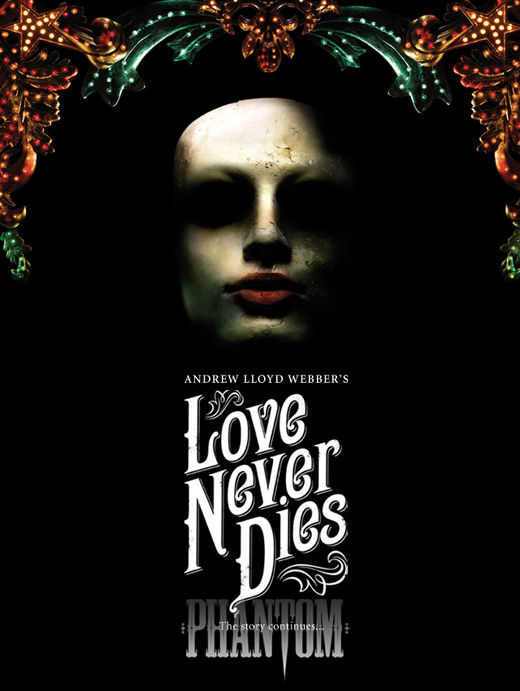
Andrew Lloyd-Webber, the Duracell bunny of the British music industry, recently composed a sequel to his 1986 hit The Phantom Of The Opera. And even more recently this, let’s call it a musical for now (just for the sake of convenience), premiered in London’s West End. I think you can guess where this review is going, yes?
The show, entitled Love Never Dies, has been long in the making. And the Phans (don’t get me started… ) have been caterwauling about how bad it’s going to be for just as long.
I was of mixed opinion about the sequel. I thought it would be really rotten, but was holding out some little, microscopic sliver of hope that it might turn out not to be. But things were looking more glum by the day year. Frederick Forsyth was the first person to collaborate with Lloyd-Webber on the script. Later, when the whole collaboration thing turned apeshit, he turned his ideas into a book called The Phantom Of Manhattan. I am not kidding when I say that this is one of the worst novels I have ever read. And I read The Green Rider. And The Sword Of Truth. So the phans (no no no!) fans might have had some reason to be concerned. After the Forsyth debacle things turned quiet around the sequel. A song emerged, which I thought was pretty (if you listened to it long enough) and around 2007 Andrew Lloyd-Webber reported that his cat had eaten the score, causing much hilarity and happiness in the fan-camp.
And then, after I had forgotten all about the show, it happened. A cast was announced. A venue. A premier date. And before I could go and hide in Antarctica the CD was lying under the easter bunny tree. (Or something.)
I had a lot of snide comments prepared for this part of the review, but I fear what they all boiled down to was: the show isn’t very good. I had read several reviews, both by phans (bad blogger!) fans and theatre critics, and what they all seemed to say is that Love Never Dies is nothing special. It was interesting to hear the way in which these opinions were expressed. The fans would say stuff like “the show wasn’t very go… I mean it was spectacular, but the story was cra… absolutely stunning if you ask me.” Whereas the critics would say things like “Andrew Lloyd-Webber’s newest offering is a gem, nay an instant classic of the musical genre, with inspiringly unremarkable tunes and a libretto that is so stunningly bad and unevocative that I think I never heard anything more brilliant in my life”. And I wish I was kidding. They were vomiting praise all over the page while at the same time some sort of deep dissatisfaction seemed to linger under all that they were writing.
And what did I think?
Lloyd-Webber has lost his edge. That’s what I think. While the show has some good melodies, unlike his The Woman In White from 2004, which mostly sounded like two hours of a cat dancing on a piano, it lacks that tune. The tune that you’ll be humming when you go out of the theatre and will still be humming the next morning under the shower. The two most successful songs are The Beauty Underneath and Devil Take The Hindmost. People who know the show will notice that I am naming the only fast songs in the show here. That is not surprising, since the entire rest of Love Never Dies is back at The Woman in White‘s cat piano dance lessons.
I lack the vocabulary to make myself clear, I’m afraid. All the other songs are bland. No climax, no tension, no nothing. Just a dancing cat. And a libretto that is so unspeakably bad that words fail me. How about I just let it speak for itself? And I touched you/ and I felt you/ and I heard those ravishing refrains… or how about All of the bonds in between us now torn/ all of the love that we gave him forsworn/ if that bastard had never been born. So, what do you think? I especially liked the “ravishing refrains,” that song (Beneath A Moonless Sky) is full of such gems, what with being the musical equivalent of softcore porn and all.

There’s good too, of course. The Beauty Underneath is an amazing duet that combines a haunting, sweet melody with really strong e-guitar riffs. And it has a message that is comprehensible. It’s about the beauty of song, of music and not about the beauty and allure of the most stupid, insipid creature to ever walk this earth, Mrs. Christine Changny née Daaé. That is one of the central problems of this show: Christine, the woman that everyone is fighting for, is as thick as a brick. Her only assets seem to be a pretty voice and nice booty. No one ever compliments her intelligence or her wit or even her kindness. She’s a blank slate, a doll. And thus it becomes even more incomprehensible when in the second good song of the show, Devil Take The Hindmost, both the Phantom and Raoul sing their talented little throats raw telling each other how much they want her. (Not very much at all, actually, because the whole thing seems to boil down to a pissing contest between the two of them. Who’s got the bigger musical… talent.)
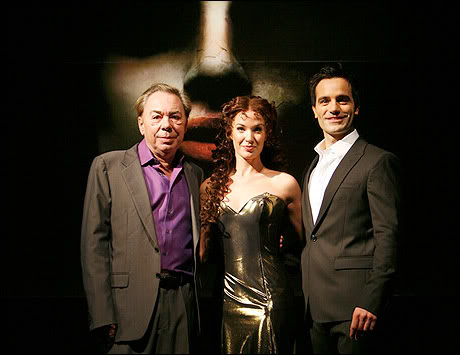
Which brings us to the question of casting: Ramin Karimloo is surely a talented singer. His voice has the raw emotion that made Michael Crawford so memorable as the original Phantom. I might say that he looks too soft for a part that is traditionally portrayed by tall, thin people, but looks don’t really matter, the voice does. Joseph Millson as Raoul is also very good. Certainly above average, even if not remarkably so, but his acting is really good. Sierra Boggess as Christine is perfectly cast… not. Unless you think that what you need to portray a bland character is a bland singer. It’s all note perfect, sure, but when she raises that pretty soprano of hers to sing Love Never Dies (a six-minute centerpiece so boring that I had to force myself to listen to all of it) all you can can do is wonder if it ever lived to begin with. Summer Strallen as Meg Giry is as good as Sally Dexter as her mother is bad. Which is to say that she is very good. And, to be fair, Miss Dexter would be good too, if some maniac hadn’t come up with the idea of saddling her with that ridiculous French accent of hers. A solitary, lonely French accent in a play where every single character is from France. And finally: I can see why Niamh Perry won that I’m-Andrew-Lloyd-Webber-Get-Me-Out-Of-Here reality-TV thing, because her voice is very nice, but it’s a shame that her character has all the depth and stage time of a badly-written Christmas pantomime henchman.
I talked a lot about the singers and the long, painful birth by caesarean section of this show, but what about the story?
I can see what you were trying to do there, Mr. Lloyd-Webber, I really can. But it doesn’t work. It is a valid approach for a sequel to mirror, echo the structure and elements of the first installment. So we do the time warp again and start with a prologue that is set in the future. A visibly aged character comes on stage and waffles on about how everything went wrong, but in a very mysterious way. Just when we think it will never end we are transported to Coney Island in 1907. The Phantom is scheming to get Christine back, although you sort of get the feeling that he just came up with the whole plan yesterday afternoon. Soon after Christine, her husband Raoul (who has been transformed into a drunken, gambling loser) and her darling son Gustave arrive. After they spectacularly fail to grasp who it is that invited them to sing at Phantasma (nudge nudge, wink wink, get it?) we get to hear them quarrel a bit, just so that there is no confusion about just how unhappy Christine is with her lot, and then the fun begins in earnest.
The Phantom reveals himself, causing Raoul no end of dismay (understandably so, seeing that last time he saw the Phantom, Mr. P tried to kill him dead), but in the end he’s a good old chap and doesn’t complain too much. Instead he goes off to have a stiff drink. Meanwhile Gustave gets treated to a nice tour of the premises, during which the Phantom discovers that apart from obvious differences in the facial department Gustave seems to be rather similar to him. Then he comes up with a bright idea and shows the kid his face, the effect of which is similar to what is was on Gustave’s mum just ten short years ago. Genetics, I suppose.
Speaking of genetics, the Phantom then has a nice chat with Christine, in which they basically say: “Oh, did we forget to mention this? We slept together about… how old is Gustave again? 10?… about 10 years and nine months ago.” Yeah, I know. Other people call it retconning, Andrew Lloyd-Webber calls it plot. And that might have been the end of the first act if Uber-Villain Madame Super-Bad Giry didn’t have to say her ten cents’ worth, which can be summed up as: “Curse you all, you’ll rue the day you crossed me, you strangely non-accented people from France.” Because she has somehow turned into a vengeful, scheming bitch. Cause that makes, like, sense.
Second Half: The Return of the BAD. Raoul has spent the interval getting pissed and is thus absolutely receptive when the Phantom steps up to him and offers him a bet. If Christine sings tonight she’ll stay with the Masked Avenger; if she doesn’t, Raoul can keep the ninny and all their debts get paid by a mysterious benefactor. Raoul thinks: “Piece of cake, I’m sure Christine will like totally understand if I tell her that the debts I caused when I gambled away all our money are high, but that we don’t need her fee for singing tonight, because I’d really rather if she didn’t.” The Phantom thinks: “Idiot”. And so they gamble and Christine sings. In a perfect world the show would be over now, but Meg Giry, who has a thing for older men whose face she has never seen in her life and who have a good reputation as a serial killer to uphold, has other plans for us. She kidnaps Gustave because… because… the script-man said so. A tragic showdown ensues. Christine gets shot. The Phantom doesn’t wring Meg’s scrawny neck because he too is secretly relieved to be rid of her and everyone lives happily ever after Coney Island burns down and everyone is miserable and alone.
Now, as I said, I see what you’re doing there. Flash forward. Creepy dolls of Christine, premature unmaskings, fights and frights over whether Christine will sing or not, everything but the god-damn falling chandelier. They have tried to do their best to mimic the original show. Homage, I suppose. Only it doesn’t work, because the whole time you’re thinking: “I know what you’re doing and it’s crap”.
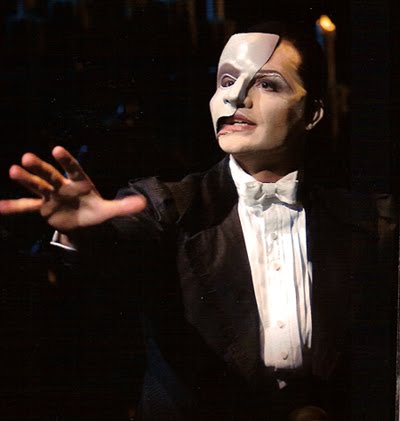
Love Never Dies fails. Not because I want it to, because I really long for another good work by Lloyd-Webber, but because it is terminally mediocre. The story seems to go nowhere, as it all centers around Christine and how everyone would like to kiss her ass. (Except Meg, which lends the final scene unintentional hilarity when the Phantom tries to talk her out of shooting Gustave by telling her that no one is perfect except her love-rival Christine. Smooth, real smooth, Mr. P.) The music wavers between strangling a cat and truly nice, i.e. it averages out into a puddle of gray musical goo, and the hummable-tune-factor is 0,oooo2%. I can’t speak for the sets, but I hear that they are beautiful and rather steampunky, which is appropriate enough.
I really want to see the show, but it’s more the kind of want to see that is related to the want to read that I feel for the latest offering by Piers Anthony. I started it, so I will finish it. Childhood infatuations never die. Just like love.
 Verena Kyratzes